

C++ Function With Multiple Parameters
How to pass multiple arguments to function ?
A Routine is a named grouping of instructions performing some tasks. A routine can ever be invoked likewise as called multiple times equally required in a given program.
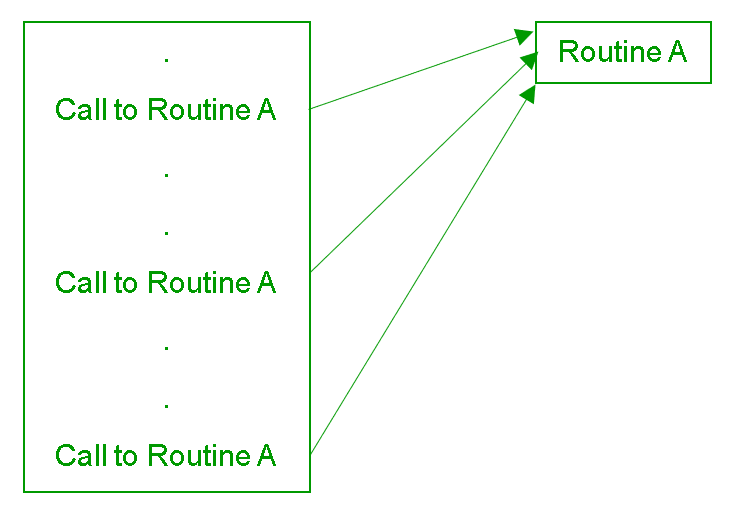
When the routine stops, the execution immediately returns to the phase from which the routine was called. Such routines may be predefined in the programming linguistic communication or designed or implemented past the developer. A Role is the Python version of the routine in a program. Some functions are designed to return values, while others are designed for other purposes.
We laissez passer arguments in a function, we can laissez passer no arguments at all, single arguments or multiple arguments to a function and tin can telephone call the function multiple times.
Example:
Python
def displayMessage():
print ( "Geeks for Geeks" )
displayMessage()
Output:
Geeks for Geeks
In the above program, the displayMessage() function is called without passing any arguments to it.
Python
def displayMessage(msg):
impress ( "Hullo " + msg + " !" )
msg = "R2J"
displayMessage(msg)
Output:
Howdy R2J !
In the above program, the displayMessage() part is called by passing an statement to it. A formal argument is an argument that is present in the function definition. An actual argument is an argument, which is nowadays in the function call.
Passing multiple arguments to a function in Python:
- Nosotros tin can pass multiple arguments to a python part by predetermining the formal parameters in the office definition.
Python
def displayMessage(argument1, argument2, argument3):
impress (argument1 + " " + argument2 + " " + argument3)
displayMessage( "Geeks" , "4" , "Geeks" )
- Output:
Geeks 4 Geeks
- In the above programme, multiple arguments are passed to the displayMessage() office in which the number of arguments to be passed was stock-still.
- We can pass multiple arguments to a python function without predetermining the formal parameters using the below syntax:
def functionName(*statement)
- The * symbol is used to pass a variable number of arguments to a function. Typically, this syntax is used to avert the code failing when nosotros don't know how many arguments will be sent to the function.
Python
def calculateTotalSum( * arguments):
totalSum = 0
for number in arguments:
totalSum + = number
print (totalSum)
calculateTotalSum( five , 4 , iii , 2 , 1 )
- Output:
15
- In the above program, the variable number of arguments are passed to the displayMessage() function in which the number of arguments to be passed is not predetermined. (This syntax is just used to laissez passer non-keyword arguments to the function.)
- We can laissez passer multiple keyword arguments to a python function without predetermining the formal parameters using the below syntax:
def functionName(**statement)
- The ** symbol is used before an statement to pass a keyword argument dictionary to a function, this syntax used to successfully run the lawmaking when we don't know how many keyword arguments will exist sent to the function.
Python
def displayArgument( * * arguments):
for arg in arguments.items():
impress (arg)
displayArgument(argument1 = "Geeks" , argument2 = 4 ,
argument3 = "Geeks" )
- Output:
('argument2', 4) ('argument3', 'Geeks') ('argument1', 'Geeks') - In the higher up program, variable number of keyword arguments are passed to the displayArgument() role.
Here is a programme to illustrate all the to a higher place cases to pass multiple arguments in a function.
Python
def displayArguments(argument1, * argument2, * * argument3):
print (argument1)
for arg in argument2:
impress (arg)
for arg in argument3.items():
impress (arg)
arg1 = "Welcome"
arg3 = "Geeks"
displayArguments(arg1, "to" , arg3, agr4 = 4 ,
arg5 = "Geeks !" )
Output:
Welcome to Geeks ('agr4', 4) ('arg5', 'Geeks!') The in a higher place plan illustrates the use of the variable number of both non-keyword arguments and keyword arguments as well equally a non-asterisk argument in a function. The non-asterisk argument is always used before the single asterisk argument and the single asterisk argument is always used earlier the double-asterisk argument in a office definition.

C++ Function With Multiple Parameters,
Source: https://www.geeksforgeeks.org/how-to-pass-multiple-arguments-to-function/
Posted by: pennywilsock.blogspot.com
0 Response to "C++ Function With Multiple Parameters"
Post a Comment