

3 25 In Simplest Form
Occam's razor, Ockham's razor, or Ocham'south razor (Latin: novacula Occami), also known as the principle of parsimony or the law of parsimony (Latin: lex parsimoniae), is the problem-solving principle that "entities should not be multiplied beyond necessity".[one] [2] It is generally understood in the sense that with competing theories or explanations, the simpler one, for example a model with fewer parameters, is to be preferred. The idea is ofttimes attributed to English language Franciscan friar William of Ockham (c. 1287–1347), a scholastic philosopher and theologian, although he never used these exact words. This philosophical razor advocates that when presented with competing hypotheses about the same prediction, one should select the solution with the fewest assumptions,[3] and that this is non meant to be a manner of choosing between hypotheses that make different predictions.
Similarly, in science, Occam's razor is used as an abductive heuristic in the development of theoretical models rather than as a rigorous arbiter between candidate models.[4] [5] In the scientific method, Occam'southward razor is non considered an irrefutable principle of logic or a scientific result; the preference for simplicity in the scientific method is based on the falsifiability criterion. For each accepted explanation of a phenomenon, in that location may be an extremely large, possibly even incomprehensible, number of possible and more complex alternatives. Since failing explanations tin ever be burdened with ad hoc hypotheses to prevent them from being falsified, simpler theories are preferable to more complex ones considering they tend to be more than testable.[6] [7] [8]
History [edit]
The phrase Occam'due south razor did not announced until a few centuries later William of Ockham'southward expiry in 1347. Libert Froidmont, in his On Christian Philosophy of the Soul, takes credit for the phrase, speaking of "novacula occami".[ix] Ockham did not invent this principle, simply the "razor"—and its association with him—may be due to the frequency and effectiveness with which he used information technology.[x] Ockham stated the principle in diverse means, but the most popular version, "Entities are not to be multiplied without necessity" ( Non sunt multiplicanda entia sine necessitate ) was formulated by the Irish Franciscan philosopher John Punch in his 1639 commentary on the works of Duns Scotus.
Formulations earlier William of Ockham [edit]

Part of a page from John Duns Scotus'south book Commentaria oxoniensia advertising IV libros magistri Sententiarus, showing the words: " Pluralitas not est ponenda sine necessitate ", i.east., "Plurality is non to exist posited without necessity"
The origins of what has come up to be known as Occam'southward razor are traceable to the works of earlier philosophers such as John Duns Scotus (1265–1308), Robert Grosseteste (1175–1253), Maimonides (Moses ben-Maimon, 1138–1204), and even Aristotle (384–322 BC).[12] [13] Aristotle writes in his Posterior Analytics, "Nosotros may assume the superiority ceteris paribus [other things being equal] of the demonstration which derives from fewer postulates or hypotheses." Ptolemy (c. AD 90 – c. 168) stated, "Nosotros consider it a adept principle to explicate the phenomena by the simplest hypothesis possible."[14]
Phrases such as "Information technology is vain to do with more what can be done with fewer" and "A plurality is not to be posited without necessity" were commonplace in 13th-century scholastic writing.[14] Robert Grosseteste, in Commentary on [Aristotle's] the Posterior Analytics Books (Commentarius in Posteriorum Analyticorum Libros) (c. 1217–1220), declares: "That is better and more valuable which requires fewer, other circumstances beingness equal... For if one matter were demonstrated from many and another thing from fewer equally known premises, clearly that is better which is from fewer because it makes us know quickly, only equally a universal sit-in is better than item because information technology produces noesis from fewer bounds. Similarly in natural scientific discipline, in moral science, and in metaphysics the all-time is that which needs no premises and the better that which needs the fewer, other circumstances being equal."[15]
The Summa Theologica of Thomas Aquinas (1225–1274) states that "it is superfluous to suppose that what can be accounted for past a few principles has been produced past many." Aquinas uses this principle to construct an objection to God'south beingness, an objection that he in plough answers and refutes by and large (cf. quinque viae), and specifically, through an statement based on causality.[16] Hence, Aquinas acknowledges the principle that today is known every bit Occam'southward razor, but prefers causal explanations to other unproblematic explanations (cf. also Correlation does not imply causation).
William of Ockham [edit]
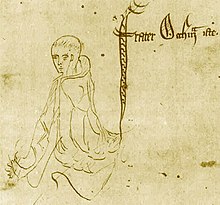
William of Ockham (circa 1287–1347) was an English Franciscan friar and theologian, an influential medieval philosopher and a nominalist. His pop fame as a great logician rests chiefly on the maxim attributed to him and known as Occam's razor. The term razor refers to distinguishing between 2 hypotheses either by "shaving away" unnecessary assumptions or cutting apart two like conclusions.
While it has been claimed that Occam's razor is not establish in whatsoever of William's writings,[17] one tin can cite statements such as Numquam ponenda est pluralitas sine necessitate William of Ockham – Wikiquote ("Plurality must never be posited without necessity"), which occurs in his theological work on the Sentences of Peter Lombard (Quaestiones et decisiones in quattuor libros Sententiarum Petri Lombardi; ed. Lugd., 1495, i, dist. 27, qu. 2, K).
Nevertheless, the precise words sometimes attributed to William of Ockham, Entia non sunt multiplicanda praeter necessitatem (Entities must not be multiplied beyond necessity),[xviii] are absent-minded in his extant works;[19] this particular phrasing comes from John Punch,[20] who described the principle every bit a "common precept" (axioma vulgare) of the Scholastics. William of Ockham's contribution seems to restrict the performance of this principle in matters pertaining to miracles and God's power; and so, in the Eucharist, a plurality of miracles is possible[ farther explanation needed ], merely because it pleases God.[14]
This principle is sometimes phrased equally Pluralitas non est ponenda sine necessitate ("Plurality should not be posited without necessity").[21] In his Summa Totius Logicae, i. 12, William of Ockham cites the principle of economic system, Frustra fit per plura quod potest fieri per pauciora ("It is futile to do with more things that which can exist done with fewer"; Thorburn, 1918, pp. 352–53; Kneale and Kneale, 1962, p. 243.)
Later formulations [edit]
To quote Isaac Newton, "Nosotros are to admit no more causes of natural things than such as are both true and sufficient to explicate their appearances. Therefore, to the aforementioned natural effects we must, as far every bit possible, assign the same causes."[22] [23] In the sentence hypotheses non fingo, Newton affirms the success of this approach.
Bertrand Russell offers a particular version of Occam's razor: "Whenever possible, substitute constructions out of known entities for inferences to unknown entities."[24]
Around 1960, Ray Solomonoff founded the theory of universal inductive inference, the theory of prediction based on observations – for example, predicting the next symbol based upon a given series of symbols. The only assumption is that the surroundings follows some unknown but computable probability distribution. This theory is a mathematical formalization of Occam's razor.[25] [26] [27]
Some other technical approach to Occam'south razor is ontological parsimony.[28] Parsimony means spareness and is also referred to as the Rule of Simplicity. This is considered a strong version of Occam's razor.[29] [xxx] A variation used in medicine is chosen the "Zebra": a physician should decline an exotic medical diagnosis when a more than commonplace explanation is more than probable, derived from Theodore Woodward's dictum "When you hear hoofbeats, think of horses not zebras".[31]
Ernst Mach formulated the stronger version of Occam's razor into physics, which he chosen the Principle of Economy stating: "Scientists must use the simplest means of arriving at their results and exclude everything not perceived by the senses."[32]
This principle goes back at to the lowest degree as far as Aristotle, who wrote "Nature operates in the shortest way possible."[29] The idea of parsimony or simplicity in deciding between theories, though not the intent of the original expression of Occam's razor, has been alloyed into common civilisation equally the widespread layman's formulation that "the simplest caption is usually the correct 1."[29]
Justifications [edit]
Artful [edit]
Prior to the 20th century, it was a commonly held belief that nature itself was unproblematic and that simpler hypotheses nigh nature were thus more than likely to exist true. This notion was deeply rooted in the aesthetic value that simplicity holds for homo thought, and the justifications presented for it often drew from theology. [ clarification needed ] Thomas Aquinas fabricated this statement in the 13th century, writing, "If a matter can be done adequately by means of ane, information technology is superfluous to do it past ways of several; for we observe that nature does not utilise two instruments [if] one suffices."[33]
Beginning in the 20th century, epistemological justifications based on induction, logic, pragmatism, and especially probability theory take become more than popular amid philosophers.[ix]
Empirical [edit]
Occam'south razor has gained strong empirical back up in helping to converge on better theories (see Uses section below for some examples).
In the related concept of overfitting, excessively circuitous models are afflicted by statistical noise (a problem besides known as the bias-variance trade-off), whereas simpler models may capture the underlying structure better and may thus accept amend predictive operation. It is, notwithstanding, often difficult to deduce which office of the data is noise (cf. model option, test fix, minimum description length, Bayesian inference, etc.).
Testing the razor [edit]
The razor'south statement that "other things beingness equal, simpler explanations are generally amend than more than complex ones" is amenable to empirical testing. Some other estimation of the razor's statement would be that "simpler hypotheses are mostly better than the circuitous ones". The procedure to exam the quondam interpretation would compare the track records of simple and comparatively complex explanations. If one accepts the starting time interpretation, the validity of Occam's razor equally a tool would then take to be rejected if the more than complex explanations were more often correct than the less circuitous ones (while the converse would lend back up to its apply). If the latter interpretation is accustomed, the validity of Occam's razor every bit a tool could possibly be accepted if the simpler hypotheses led to correct conclusions by and large.

Possible explanations can get needlessly circuitous. It might be coherent, for instance, to add the involvement of leprechauns to whatsoever explanation, merely Occam's razor would prevent such additions unless they were necessary.
Even if some increases in complexity are sometimes necessary, at that place withal remains a justified general bias toward the simpler of two competing explanations. To understand why, consider that for each accepted explanation of a phenomenon, at that place is always an infinite number of possible, more than complex, and ultimately incorrect, alternatives. This is so because one can always burden a failing explanation with an advertizing hoc hypothesis. Ad hoc hypotheses are justifications that prevent theories from being falsified.
For example, if a man, accused of breaking a vase, makes supernatural claims that leprechauns were responsible for the breakage, a elementary explanation might be that the human did it, just ongoing ad hoc justifications (e.one thousand. "... and that's not me breaking it on the pic; they tampered with that, as well") could successfully prevent complete disproof. This endless supply of elaborate competing explanations, called saving hypotheses, cannot be technically ruled out – except by using Occam'south razor.[34] [35] [36]
Whatsoever more complex theory might still mayhap exist true. A study of the predictive validity of Occam's razor found 32 published papers that included 97 comparisons of economic forecasts from simple and complex forecasting methods. None of the papers provided a balance of testify that complexity of method improved forecast accuracy. In the 25 papers with quantitative comparisons, complexity increased forecast errors past an average of 27 percent.[37]
Practical considerations and pragmatism [edit]
Mathematical [edit]
Ane justification of Occam's razor is a direct result of basic probability theory. By definition, all assumptions introduce possibilities for error; if an assumption does not ameliorate the accuracy of a theory, its only effect is to increase the probability that the overall theory is wrong.
In that location take likewise been other attempts to derive Occam's razor from probability theory, including notable attempts fabricated by Harold Jeffreys and E. T. Jaynes. The probabilistic (Bayesian) basis for Occam's razor is elaborated by David J. C. MacKay in chapter 28 of his volume Information Theory, Inference, and Learning Algorithms,[38] where he emphasizes that a prior bias in favor of simpler models is non required.
William H. Jefferys and James O. Berger (1991) generalize and quantify the original formulation's "assumptions" concept equally the degree to which a suggestion is unnecessarily accommodating to possible observable information.[39] They state, "A hypothesis with fewer adjustable parameters will automatically have an enhanced posterior probability, due to the fact that the predictions information technology makes are abrupt."[39] The use of "sharp" hither is not only a natural language-in-cheek reference to the idea of a razor, just too indicates that such predictions are more accurate than competing predictions. The model they advise balances the precision of a theory's predictions confronting their sharpness, preferring theories that sharply make correct predictions over theories that accommodate a wide range of other possible results. This, again, reflects the mathematical relationship between key concepts in Bayesian inference (namely marginal probability, provisional probability, and posterior probability).
The bias–variance tradeoff is a framework that incorporates the Occam'southward razor principle in its balance between overfitting (associated with lower bias but higher variance) and underfitting (associated with lower variance but higher bias).[twoscore]
Other philosophers [edit]
Karl Popper [edit]
Karl Popper argues that a preference for simple theories need not entreatment to applied or artful considerations. Our preference for simplicity may be justified by its falsifiability criterion: we prefer simpler theories to more than circuitous ones "because their empirical content is greater; and because they are better testable".[41] The idea here is that a simple theory applies to more cases than a more complex 1, and is thus more easily falsifiable. This is again comparing a simple theory to a more complex theory where both explicate the data equally well.
Elliott Sober [edit]
The philosopher of science Elliott Sober once argued forth the aforementioned lines equally Popper, tying simplicity with "informativeness": The simplest theory is the more informative, in the sense that information technology requires less information to a question.[42] He has since rejected this account of simplicity, purportedly because it fails to provide an epistemic justification for simplicity. He now believes that simplicity considerations (and considerations of parsimony in item) practice not count unless they reflect something more fundamental. Philosophers, he suggests, may have made the error of hypostatizing simplicity (i.e., endowed it with a sui generis existence), when it has meaning only when embedded in a specific context (Sober 1992). If we fail to justify simplicity considerations on the basis of the context in which we use them, nosotros may have no not-circular justification: "Only as the question 'why be rational?' may have no non-round reply, the same may be true of the question 'why should simplicity be considered in evaluating the plausibility of hypotheses?'"[43]
Richard Swinburne [edit]
Richard Swinburne argues for simplicity on logical grounds:
... the simplest hypothesis proposed equally an caption of phenomena is more than probable to be the true one than is any other available hypothesis, that its predictions are more likely to exist true than those of any other available hypothesis, and that it is an ultimate a priori epistemic principle that simplicity is bear witness for truth.
—Swinburne 1997
According to Swinburne, since our choice of theory cannot exist determined by data (see Underdetermination and Duhem–Quine thesis), nosotros must rely on some criterion to determine which theory to use. Since it is absurd to take no logical method for settling on one hypothesis amid an infinite number of equally data-compliant hypotheses, we should cull the simplest theory: "Either science is irrational [in the way it judges theories and predictions probable] or the principle of simplicity is a central synthetic a priori truth.".[44]
Ludwig Wittgenstein [edit]
From the Tractatus Logico-Philosophicus:
- 3.328 "If a sign is non necessary then information technology is meaningless. That is the pregnant of Occam's Razor."
- (If everything in the symbolism works as though a sign had significant, then it has significant.)
- four.04 "In the proposition, in that location must be exactly as many things distinguishable equally there are in the state of affairs, which it represents. They must both possess the aforementioned logical (mathematical) multiplicity (cf. Hertz's Mechanics, on Dynamic Models)."
- five.47321 "Occam's Razor is, of class, non an arbitrary rule nor one justified past its practical success. Information technology simply says that unnecessary elements in a symbolism mean cipher. Signs which serve ane purpose are logically equivalent; signs which serve no purpose are logically meaningless."
and on the related concept of "simplicity":
- 6.363 "The procedure of induction consists in accepting as true the simplest law that can be reconciled with our experiences."
Uses [edit]
Science and the scientific method [edit]

In science, Occam's razor is used as a heuristic to guide scientists in developing theoretical models rather than every bit an arbiter between published models.[iv] [5] In physics, parsimony was an important heuristic in Albert Einstein's formulation of special relativity,[45] [46] in the evolution and application of the principle of least activeness by Pierre Louis Maupertuis and Leonhard Euler,[47] and in the development of quantum mechanics past Max Planck, Werner Heisenberg and Louis de Broglie.[five] [48]
In chemistry, Occam's razor is oftentimes an important heuristic when developing a model of a reaction mechanism.[49] [50] Although information technology is useful every bit a heuristic in developing models of reaction mechanisms, it has been shown to fail every bit a criterion for selecting among some selected published models.[5] In this context, Einstein himself expressed circumspection when he formulated Einstein's Constraint: "Information technology can scarcely be denied that the supreme goal of all theory is to make the irreducible basic elements as elementary and equally few as possible without having to surrender the acceptable representation of a single datum of experience". An often-quoted version of this constraint (which cannot exist verified as posited by Einstein himself)[51] says "Everything should exist kept every bit uncomplicated as possible, but not simpler."
In the scientific method, parsimony is an epistemological, metaphysical or heuristic preference, not an irrefutable principle of logic or a scientific result.[6] [7] [8] As a logical principle, Occam'due south razor would need that scientists accept the simplest possible theoretical explanation for existing data. Withal, science has shown repeatedly that futurity data often support more circuitous theories than practice existing information. Scientific discipline prefers the simplest explanation that is consequent with the data available at a given time, but the simplest caption may be ruled out as new data become available.[4] [seven] That is, scientific discipline is open to the possibility that hereafter experiments might support more complex theories than demanded by electric current data and is more interested in designing experiments to discriminate between competing theories than favoring i theory over some other based just on philosophical principles.[6] [7] [viii]
When scientists use the idea of parsimony, it has pregnant simply in a very specific context of inquiry. Several background assumptions are required for parsimony to connect with plausibility in a particular enquiry problem.[ clarification needed ] The reasonableness of parsimony in one research context may have nothing to practice with its reasonableness in another. It is a mistake to think that at that place is a single global principle that spans diverse subject matter.[8]
Information technology has been suggested that Occam'due south razor is a widely accepted example of extraevidential consideration, even though it is entirely a metaphysical supposition. Most of the time, however, Occam's razor is a bourgeois tool, cutting out "crazy, complicated constructions" and assuring "that hypotheses are grounded in the science of the day", thus yielding "normal" science: models of explanation and prediction.[5] There are, however, notable exceptions where Occam'southward razor turns a bourgeois scientist into a reluctant revolutionary. For instance, Max Planck interpolated between the Wien and Jeans radiation laws and used Occam's razor logic to formulate the breakthrough hypothesis, even resisting that hypothesis every bit it became more obvious that it was correct.[5]
Appeals to simplicity were used to argue against the phenomena of meteorites, brawl lightning, continental drift, and reverse transcriptase.[52] One can argue for diminutive building blocks for thing, because it provides a simpler explanation for the observed reversibility of both mixing [ clarification needed ] and chemical reactions as simple separation and rearrangements of atomic edifice blocks. At the time, however, the atomic theory was considered more circuitous because it implied the beingness of invisible particles that had not been directly detected. Ernst Mach and the logical positivists rejected John Dalton's atomic theory until the reality of atoms was more axiomatic in Brownian motion, as shown past Albert Einstein.[53]
In the aforementioned way, postulating the aether is more circuitous than transmission of light through a vacuum. At the time, nonetheless, all known waves propagated through a physical medium, and it seemed simpler to postulate the being of a medium than to theorize well-nigh wave propagation without a medium. Likewise, Isaac Newton'south idea of light particles seemed simpler than Christiaan Huygens'southward idea of waves, so many favored it. In this case, as it turned out, neither the wave—nor the particle—explanation solitary suffices, every bit light behaves like waves and like particles.
Three axioms presupposed by the scientific method are realism (the existence of objective reality), the being of natural laws, and the constancy of natural law. Rather than depend on provability of these axioms, science depends on the fact that they have not been objectively falsified. Occam'south razor and parsimony support, but practice not prove, these axioms of scientific discipline. The general principle of science is that theories (or models) of natural police must be consistent with repeatable experimental observations. This ultimate czar (selection benchmark) rests upon the axioms mentioned above.[7]
If multiple models of natural law brand exactly the aforementioned testable predictions, they are equivalent and at that place is no need for parsimony to cull a preferred one. For instance, Newtonian, Hamiltonian and Lagrangian classical mechanics are equivalent. Physicists have no involvement in using Occam's razor to say the other ii are wrong. Too, in that location is no need for simplicity principles to arbitrate between wave and matrix formulations of quantum mechanics. Science often does not demand arbitration or selection criteria between models that make the same testable predictions.[7]
Biology [edit]
Biologists or philosophers of biology use Occam's razor in either of 2 contexts both in evolutionary biology: the units of selection controversy and systematics. George C. Williams in his book Adaptation and Natural Selection (1966) argues that the best way to explain altruism amongst animals is based on low-level (i.due east., individual) selection every bit opposed to high-level group option. Altruism is defined by some evolutionary biologists (due east.g., R. Alexander, 1987; West. D. Hamilton, 1964) every bit behavior that is beneficial to others (or to the group) at a cost to the individual, and many posit individual selection as the mechanism that explains altruism solely in terms of the behaviors of private organisms acting in their own self-interest (or in the interest of their genes, via kin selection). Williams was arguing confronting the perspective of others who propose selection at the level of the group as an evolutionary mechanism that selects for donating traits (due east.grand., D. South. Wilson & East. O. Wilson, 2007). The footing for Williams' contention is that of the two, individual selection is the more parsimonious theory. In doing and so he is invoking a variant of Occam's razor known as Morgan'due south Catechism: "In no example is an animal activity to exist interpreted in terms of higher psychological processes, if information technology can exist adequately interpreted in terms of processes which stand up lower in the scale of psychological evolution and development." (Morgan 1903).
Still, more contempo biological analyses, such as Richard Dawkins' The Selfish Cistron, have contended that Morgan's Canon is not the simplest and well-nigh basic explanation. Dawkins argues the way evolution works is that the genes propagated in well-nigh copies terminate upwardly determining the evolution of that particular species, i.e., natural selection turns out to select specific genes, and this is really the fundamental underlying principle that automatically gives individual and grouping selection equally emergent features of evolution.
Zoology provides an case. Muskoxen, when threatened past wolves, form a circle with the males on the exterior and the females and young on the inside. This is an example of a behavior past the males that seems to be donating. The behavior is disadvantageous to them individually but beneficial to the group as a whole and was thus seen by some to support the group choice theory. Another interpretation is kin selection: if the males are protecting their offspring, they are protecting copies of their own alleles. Engaging in this behavior would be favored by private selection if the cost to the male musk ox is less than one-half of the benefit received past his calf – which could easily be the example if wolves have an easier time killing calves than adult males. Information technology could also be the case that male person musk oxen would exist individually less likely to exist killed by wolves if they stood in a circle with their horns pointing out, regardless of whether they were protecting the females and offspring. That would be an example of regular natural selection – a phenomenon called "the selfish herd".
Systematics is the branch of biology that attempts to found patterns of relationship amid biological taxa, today generally thought to reverberate evolutionary history. Information technology is besides concerned with their classification. There are 3 primary camps in systematics: cladists, pheneticists, and evolutionary taxonomists. Cladists hold that classification should exist based on synapomorphies (shared, derived grapheme states), pheneticists contend that overall similarity (synapomorphies and complementary symplesiomorphies) is the determining criterion, while evolutionary taxonomists say that both genealogy and similarity count in classification (in a manner determined by the evolutionary taxonomist).[54] [55]
It is amongst the cladists that Occam's razor is practical, through the method of cladistic parsimony. Cladistic parsimony (or maximum parsimony) is a method of phylogenetic inference that yields phylogenetic trees (more than specifically, cladograms). Cladograms are branching, diagrams used to represent hypotheses of relative caste of human relationship, based on synapomorphies. Cladistic parsimony is used to select as the preferred hypothesis of relationships the cladogram that requires the fewest unsaid character state transformations (or smallest weight, if characters are differentially weighted). Critics of the cladistic approach often observe that for some types of data, parsimony could produce the wrong results, regardless of how much data is collected (this is chosen statistical inconsistency, or long branch attraction). However, this criticism is also potentially true for any type of phylogenetic inference, unless the model used to estimate the tree reflects the way that evolution really happened. Because this information is not empirically attainable, the criticism of statistical inconsistency against parsimony holds no force.[56] For a book-length handling of cladistic parsimony, see Elliott Sober's Reconstructing the Past: Parsimony, Evolution, and Inference (1988). For a discussion of both uses of Occam's razor in biology, encounter Sober's article "Let's Razor Ockham's Razor" (1990).
Other methods for inferring evolutionary relationships use parsimony in a more general style. Likelihood methods for phylogeny use parsimony as they do for all likelihood tests, with hypotheses requiring fewer differing parameters (i.e., numbers or different rates of graphic symbol alter or different frequencies of character state transitions) being treated as null hypotheses relative to hypotheses requiring more differing parameters. Thus, complex hypotheses must predict information much meliorate than do elementary hypotheses before researchers reject the simple hypotheses. Contempo advances use information theory, a shut cousin of likelihood, which uses Occam'due south razor in the same way. Of course, the option of the "shortest tree" relative to a not-so-short tree under any optimality criterion (smallest distance, fewest steps, or maximum likelihood) is always based on parsimony [57]
Francis Crick has commented on potential limitations of Occam'southward razor in biological science. He advances the argument that because biological systems are the products of (an ongoing) natural selection, the mechanisms are not necessarily optimal in an obvious sense. He cautions: "While Ockham's razor is a useful tool in the physical sciences, it can exist a very unsafe implement in biology. It is thus very rash to use simplicity and elegance every bit a guide in biological research."[58] This is an ontological critique of parsimony.
In biogeography, parsimony is used to infer ancient vicariant events or migrations of species or populations past observing the geographic distribution and relationships of existing organisms. Given the phylogenetic tree, ancestral population subdivisions are inferred to be those that require the minimum amount of change.
Religion [edit]
In the philosophy of religion, Occam'southward razor is sometimes applied to the existence of God. William of Ockham himself was a Christian. He believed in God, and in the authority of Scripture; he writes that "zippo ought to be posited without a reason given, unless information technology is cocky-evident (literally, known through itself) or known past experience or proved by the potency of Sacred Scripture."[59] Ockham believed that an explanation has no sufficient ground in reality when it does not harmonize with reason, experience, or the Bible. However, unlike many theologians of his time, Ockham did not believe God could be logically proven with arguments. To Ockham, scientific discipline was a affair of discovery, but theology was a matter of revelation and faith. He states: "only organized religion gives us access to theological truths. The ways of God are non open up to reason, for God has freely chosen to create a world and establish a manner of conservancy within it apart from any necessary laws that human logic or rationality tin uncover."[lx]
St. Thomas Aquinas, in the Summa Theologica, uses a formulation of Occam's razor to construct an objection to the thought that God exists, which he refutes directly with a counterargument:[61]
Farther, information technology is superfluous to suppose that what can exist accounted for by a few principles has been produced past many. But it seems that everything we meet in the globe can exist accounted for by other principles, supposing God did not exist. For all natural things tin can be reduced to i principle which is nature; and all voluntary things tin can be reduced to one principle which is homo reason, or volition. Therefore in that location is no demand to suppose God's existence.
In plow, Aquinas answers this with the quinque viae, and addresses the item objection above with the following answer:
Since nature works for a determinate end under the direction of a higher agent, whatever is done by nature must needs be traced back to God, as to its first cause. So as well any is washed voluntarily must also exist traced back to some higher crusade other than man reason or will, since these can change or neglect; for all things that are changeable and capable of defect must exist traced back to an immovable and self-necessary start principle, every bit was shown in the body of the Article.
Rather than argue for the necessity of a god, some theists base their belief upon grounds independent of, or prior to, reason, making Occam's razor irrelevant. This was the opinion of Søren Kierkegaard, who viewed belief in God as a bound of faith that sometimes directly opposed reason.[62] This is also the doctrine of Gordon Clark's presuppositional apologetics, with the exception that Clark never thought the spring of faith was contrary to reason (see also Fideism).
Various arguments in favor of God constitute God as a useful or even necessary supposition. Contrastingly some anti-theists hold firmly to the belief that assuming the existence of God introduces unnecessary complexity (Schmitt 2005, due east.thou., the Ultimate Boeing 747 gambit).
Another awarding of the principle is to be found in the work of George Berkeley (1685–1753). Berkeley was an idealist who believed that all of reality could be explained in terms of the mind alone. He invoked Occam'south razor confronting materialism, stating that thing was non required by his metaphysics and was thus eliminable. One potential problem with this conventionalities[ for whom? ] is that it's possible, given Berkeley'south position, to find solipsism itself more in line with the razor than a God-mediated world beyond a single thinker.
Occam's razor may too be recognized in the counterfeit story most an exchange between Pierre-Simon Laplace and Napoleon. It is said that in praising Laplace for one of his recent publications, the emperor asked how it was that the name of God, which featured and so frequently in the writings of Lagrange, appeared nowhere in Laplace's. At that, he is said to accept replied, "It's because I had no need of that hypothesis."[63] Though some points of this story illustrate Laplace's atheism, more careful consideration suggests that he may instead have intended merely to illustrate the power of methodological naturalism, or fifty-fifty simply that the fewer logical premises one assumes, the stronger is one's conclusion.
Philosophy of mind [edit]
In his commodity "Sensations and Encephalon Processes" (1959), J. J. C. Smart invoked Occam's razor with the aim to justify his preference of the mind-brain identity theory over spirit-trunk dualism. Dualists land that there are ii kinds of substances in the universe: physical (including the body) and spiritual, which is non-physical. In dissimilarity, identity theorists state that everything is concrete, including consciousness, and that at that place is aught nonphysical. Though information technology is impossible to appreciate the spiritual when limiting oneself to the physical[ commendation needed ], Smart maintained that identity theory explains all phenomena past bold merely a physical reality. Subsequently, Smart has been severely criticized for his use (or misuse) of Occam's razor and ultimately retracted his advocacy of it in this context. Paul Churchland (1984) states that by itself Occam's razor is inconclusive regarding duality. In a like fashion, Dale Jacquette (1994) stated that Occam'southward razor has been used in attempts to justify eliminativism and reductionism in the philosophy of mind. Eliminativism is the thesis that the ontology of folk psychology including such entities equally "hurting", "joy", "desire", "fearfulness", etc., are eliminable in favor of an ontology of a completed neuroscience.
Penal ethics [edit]
In penal theory and the philosophy of punishment, parsimony refers specifically to taking care in the distribution of punishment in order to avoid excessive punishment. In the commonsensical approach to the philosophy of penalization, Jeremy Bentham's "parsimony principle" states that any punishment greater than is required to achieve its end is unjust. The concept is related but not identical to the legal concept of proportionality. Parsimony is a primal consideration of the modern restorative justice, and is a component of commonsensical approaches to punishment, as well as the prison abolition movement. Bentham believed that truthful parsimony would require penalisation to be individualised to have account of the sensibility of the individual—an individual more sensitive to punishment should be given a proportionately lesser 1, since otherwise needless pain would be inflicted. Later utilitarian writers have tended to abandon this idea, in large function due to the impracticality of determining each alleged criminal'south relative sensitivity to specific punishments.[64]
Probability theory and statistics [edit]
Marcus Hutter's universal bogus intelligence builds upon Solomonoff's mathematical formalization of the razor to calculate the expected value of an action.
At that place are various papers in scholarly journals deriving formal versions of Occam'south razor from probability theory, applying it in statistical inference, and using it to come up with criteria for penalizing complication in statistical inference. Papers[65] [66] have suggested a connection between Occam's razor and Kolmogorov complication.[67]
1 of the problems with the original formulation of the razor is that information technology merely applies to models with the same explanatory ability (i.e., it only tells usa to prefer the simplest of equally skillful models). A more general form of the razor can exist derived from Bayesian model comparison, which is based on Bayes factors and tin can be used to compare models that don't fit the observations equally well. These methods can sometimes optimally balance the complication and power of a model. By and large, the exact Occam cistron is intractable, but approximations such as Akaike data criterion, Bayesian information benchmark, Variational Bayesian methods, false discovery rate, and Laplace'southward method are used. Many artificial intelligence researchers are now employing such techniques, for instance through work on Occam Learning or more than generally on the Free free energy principle.
Statistical versions of Occam'southward razor have a more than rigorous formulation than what philosophical discussions produce. In particular, they must have a specific definition of the term simplicity, and that definition tin vary. For example, in the Kolmogorov–Chaitin minimum description length approach, the subject must pick a Turing machine whose operations describe the basic operations believed to correspond "simplicity" by the field of study. However, one could always choose a Turing machine with a elementary operation that happened to construct ane's unabridged theory and would hence score highly nether the razor. This has led to two opposing camps: one that believes Occam'southward razor is objective, and ane that believes it is subjective.
Objective razor [edit]
The minimum instruction prepare of a universal Turing machine requires approximately the same length description across dissimilar formulations, and is small compared to the Kolmogorov complexity of most practical theories. Marcus Hutter has used this consistency to ascertain a "natural" Turing motorcar of small size every bit the proper ground for excluding arbitrarily circuitous instruction sets in the conception of razors.[68] Describing the programme for the universal program every bit the "hypothesis", and the representation of the evidence as program data, it has been formally proven nether Zermelo–Fraenkel fix theory that "the sum of the log universal probability of the model plus the log of the probability of the data given the model should exist minimized."[69] Interpreting this every bit minimising the total length of a ii-part message encoding model followed by data given model gives us the minimum message length (MML) principle.[65] [66]
One possible conclusion from mixing the concepts of Kolmogorov complexity and Occam's razor is that an ideal data compressor would also exist a scientific explanation/formulation generator. Some attempts have been made to re-derive known laws from considerations of simplicity or compressibility.[26] [70]
According to Jürgen Schmidhuber, the appropriate mathematical theory of Occam'south razor already exists, namely, Solomonoff's theory of optimal inductive inference[71] and its extensions.[72] See discussions in David L. Dowe's "Foreword re C. South. Wallace"[73] for the subtle distinctions between the algorithmic probability work of Solomonoff and the MML work of Chris Wallace, and come across Dowe's "MML, hybrid Bayesian network graphical models, statistical consistency, invariance and uniqueness"[74] both for such discussions and for (in section four) discussions of MML and Occam's razor. For a specific example of MML every bit Occam's razor in the problem of decision tree consecration, run across Dowe and Needham's "Message Length every bit an Effective Ockham's Razor in Decision Tree Induction".[75]
Software Development [edit]
In software evolution, the dominion of to the lowest degree power argues the correct programming linguistic communication to use is the one that is simplest while also solving the targeted software problem. In that course the rule is often credited to Tim Berners-Lee since it appeared in his design guidelines for the original Hypertext Transfer Protocol.[76] Complexity in this context is measured either by placing a language into the Chomsky hierarchy or past list idiomatic features of the linguistic communication and comparing according to some agreed to scale of difficulties between idioms. Many languages in one case thought to be of lower complexity have evolved or later been discovered to be more complex than originally intended; then, in practise this rule is applied to the relative ease of a programmer to obtain the power of the language, rather than the precise theoretical limits of the linguistic communication.
Controversial aspects [edit]
Occam's razor is not an embargo against the positing of any kind of entity, or a recommendation of the simplest theory come up what may.[a] Occam'due south razor is used to adjudicate between theories that have already passed "theoretical scrutiny" tests and are equally well-supported by evidence.[b] Furthermore, it may exist used to prioritize empirical testing between ii as plausible merely unequally testable hypotheses; thereby minimizing costs and wastes while increasing chances of falsification of the simpler-to-exam hypothesis.[ citation needed ]
Another contentious aspect of the razor is that a theory tin can become more complex in terms of its structure (or syntax), while its ontology (or semantics) becomes simpler, or vice versa.[c] Quine, in a discussion on definition, referred to these ii perspectives as "economy of applied expression" and "economy in grammar and vocabulary", respectively.[78]
Galileo Galilei lampooned the misuse of Occam'south razor in his Dialogue. The principle is represented in the dialogue by Simplicio. The telling betoken that Galileo presented ironically was that if 1 really wanted to showtime from a modest number of entities, one could always consider the messages of the alphabet equally the fundamental entities, since i could construct the whole of human knowledge out of them.
Anti-razors [edit]
Occam'due south razor has met some opposition from people who accept considered information technology too extreme or rash. Walter Chatton (c. 1290–1343) was a contemporary of William of Ockham who took exception to Occam's razor and Ockham'south use of it. In response he devised his own anti-razor: "If three things are not enough to verify an affirmative proposition about things, a 4th must be added, and and then on." Although there accept been a number of philosophers who have formulated similar anti-razors since Chatton's fourth dimension, no one anti-razor has perpetuated in as much notability as Chatton'south anti-razor, although this could be the case of the Belatedly Renaissance Italian motto of unknown attribution Se non è vero, è ben trovato ("Fifty-fifty if it is not true, information technology is well conceived") when referred to a particularly artful explanation.
Anti-razors accept also been created by Gottfried Wilhelm Leibniz (1646–1716), Immanuel Kant (1724–1804), and Karl Menger (1902–1985). Leibniz's version took the form of a principle of plenitude, every bit Arthur Lovejoy has called information technology: the thought being that God created the well-nigh varied and populous of possible worlds. Kant felt a need to moderate the effects of Occam'due south razor and thus created his own counter-razor: "The diverseness of beings should not rashly exist macerated."[79]
Karl Menger found mathematicians to be as well parsimonious with regard to variables, so he formulated his Law Against Miserliness, which took one of two forms: "Entities must not exist reduced to the point of inadequacy" and "It is vain to do with fewer what requires more." A less serious but even more extremist anti-razor is 'Pataphysics, the "science of imaginary solutions" adult by Alfred Jarry (1873–1907). Perhaps the ultimate in anti-reductionism, "'Pataphysics seeks no less than to view each consequence in the universe as completely unique, subject to no laws but its ain." Variations on this theme were subsequently explored by the Argentine writer Jorge Luis Borges in his story/mock-essay "Tlön, Uqbar, Orbis Tertius". Physicist R. V. Jones contrived Crabtree'south Bludgeon, which states that "[n]o ready of mutually inconsistent observations can exist for which some man intellect cannot conceive a coherent explanation, yet complicated."[80]
Come across also [edit]
- Chekhov's gun – Dramatic principle that every chemical element in a story must be necessary
- Explanatory power – Ability of a theory to explain a subject
- Hanlon's razor – Adage to assume stupidity over malice
- Hickam'due south dictum – Medical principle that a patient's symptoms could be caused by several diseases
- Hitchens'due south razor – Epistemological razor
- KISS principle – Design principle preferring simplicity
- Minimum description length – Model pick principle
- Minimum message length – Formal information theory restatement of Occam's Razor
- Newton's flaming laser sword
- Philosophical razor – Principle that allows one to eliminate unlikely explanations
- Philosophy of scientific discipline – Written report of assumptions/bases/implications of scientific discipline
- Simplicity – State of being elementary
- Duck test – Classification based on observable prove
Notes [edit]
- ^ "Ockham's razor does not say that the more simple a hypothesis, the better."[77]
- ^ "Today, we think of the principle of parsimony as a heuristic device. We don't assume that the simpler theory is correct and the more circuitous one simulated. We know from experience that mostly the theory that requires more complicated machinations is incorrect. Until proved otherwise, the more complex theory competing with a simpler explanation should exist put on the back burner, but not thrown onto the trash heap of history until proven simulated."[77]
- ^ "While these 2 facets of simplicity are often conflated, it is important to treat them as singled-out. One reason for doing so is that considerations of parsimony and of elegance typically pull in unlike directions. Postulating extra entities may allow a theory to be formulated more simply, while reducing the ontology of a theory may but be possible at the toll of making it syntactically more circuitous."[6]
References [edit]
- ^ Barry, C. M. (27 May 2014). "Who sharpened Occam'due south Razor?". Irish Philosophy.
- ^ Schaffer, Jonathan (2015). "What Not to Multiply Without Necessity" (PDF). Australasian Journal of Philosophy. 93 (4): 644–664. doi:x.1080/00048402.2014.992447. S2CID 16923735.
- ^ "What is Occam's Razor?". math.ucr.edu . Retrieved 1 June 2019.
- ^ a b c Hugh M. Gauch, Scientific Method in Practice, Cambridge University Printing, 2003, ISBN 0-521-01708-4, ISBN 978-0-521-01708-4.
- ^ a b c d e f Hoffman, Roald; Minkin, Vladimir I.; Carpenter, Barry K. (1997). "Ockham'southward Razor and Chemistry". International Journal for Philosophy of Chemistry. iii: 3–28.
- ^ a b c d Alan Baker (2010) [2004]. "Simplicity". Stanford Encyclopedia of Philosophy. California: Stanford Academy. ISSN 1095-5054.
- ^ a b c d eastward f Courtney, A.; Courtney, G. (2008). "Comments Regarding 'On the Nature of Scientific discipline'". Physics in Canada. 64 (3): 7–8. arXiv:0812.4932. Bibcode:2008arXiv0812.4932C.
- ^ a b c d Sober, Elliott (1994). "Let'south Razor Occam'southward Razor". In Knowles, Dudley (ed.). Explanation and Its Limits. Cambridge University Press. pp. 73–93.
- ^ a b Sober, Elliott (2015). Ockam's Razor: A User'southward Transmission. Cambridge University Press. p. iv. ISBN978-1107692534.
- ^ Roger Ariew, Ockham's Razor: A Historical and Philosophical Analysis of Ockham's Principle of Parsimony, 1976
- ^ Aristotle, Physics 189a15, On the Heavens 271a33. See also Franklin, op cit. note 44 to chap. 9.
- ^ Charlesworth, M. J. (1956). "Aristotle's Razor". Philosophical Studies. six: 105–112. doi:10.5840/philstudies1956606.
- ^ a b c Franklin, James (2001). The Scientific discipline of Conjecture: Evidence and Probability before Pascal. The Johns Hopkins University Printing. Chap nine. p. 241.
- ^ Alistair Cameron Crombie, Robert Grosseteste and the Origins of Experimental Scientific discipline 1100–1700 (1953) pp. 85–86
- ^ "SUMMA THEOLOGICA: The being of God (Prima Pars, Q. 2)". Newadvent.org. Archived from the original on 28 April 2013. Retrieved 26 March 2013.
- ^ Vallee, Jacques (11 Feb 2013). "What Ockham really said". Boing Boing. Archived from the original on 31 March 2013. Retrieved 26 March 2013.
- ^ Bauer, Laurie (2007). The linguistics Student'due south Handbook. Edinburgh: Edinburgh University Printing. p. 155.
- ^ Flew, Antony (1979). A Dictionary of Philosophy. London: Pan Books. p. 253.
- ^ Crombie, Alistair Cameron (1959), Medieval and Early on Modern Philosophy, Cambridge, MA: Harvard, Vol. two, p. 30.
- ^ "Ockham'southward razor". Encyclopædia Britannica. Encyclopædia Britannica Online. 2010. Archived from the original on 23 August 2010. Retrieved 12 June 2010.
- ^ Hawking, Stephen (2003). On the Shoulders of Giants. Running Press. p. 731. ISBN978-0-7624-1698-1 . Retrieved 24 Feb 2016.
- ^ Main source: Newton (2011, p. 387) wrote the following two "philosophizing rules" at the commencement of role iii of the Principia 1726 edition.
- Regula I. Causas rerum naturalium non-plures admitti debere, quam quæ & veræ sint & earum phænomenis explicandis sufficient.
- Regula II. Ideoque effectuum naturalium ejusdem generis eædem assignandæ sunt causæ, quatenus fieri potest.
- ^ Logical Constructions. Metaphysics Inquiry Lab, Stanford University. 2016.
- ^ Induction: From Kolmogorov and Solomonoff to De Finetti and Back to Kolmogorov JJ McCall – Metroeconomica, 2004 – Wiley Online Library.
- ^ a b Soklakov, A. Northward. (2002). "Occam'southward Razor as a formal footing for a physical theory". Foundations of Physics Letters. 15 (2): 107–135. arXiv:math-ph/0009007. Bibcode:2000math.ph...9007S. doi:10.1023/A:1020994407185. S2CID 14940740.
- ^ Rathmanner, Samuel; Hutter, Marcus (2011). "A philosophical treatise of universal induction". Entropy. xiii (6): 1076–1136. arXiv:1105.5721. Bibcode:2011Entrp..13.1076R. doi:10.3390/e13061076. S2CID 2499910.
- ^ Baker, Alan (25 February 2010). "Simplicity". In Zalta, Edward N. (ed.). The Stanford Encyclopedia of Philosophy (Summer 2011 Edition).
- ^ a b c "What is Occam's Razor?". math.ucr.edu. Archived from the original on half-dozen July 2017.
- ^ Stormy Dawn (17 July 2017). Everywhere The Soles of Your Anxiety Shall Tread. ISBN9781480838024.
- ^ Sotos, John G. (2006) [1991]. Zebra Cards: An Aid to Obscure Diagnoses. Mt. Vernon, VA: Mt. Vernon Volume Systems. ISBN978-0-9818193-0-3.
- ^ Becher, Erich (1905). "The Philosophical Views of Ernst Mach". The Philosophical Review. 14 (5): 535–562. doi:ten.2307/2177489. JSTOR 2177489.
- ^ Pegis 1945.
- ^ Stanovich, Keith Eastward. (2007). How to Think Straight Nigh Psychology. Boston: Pearson Instruction, pp. nineteen–33.
- ^ "advert hoc hypothesis - The Skeptic's Lexicon - Skepdic.com". skepdic.com. Archived from the original on 27 April 2009.
- ^ Swinburne 1997 and Williams, Gareth T, 2008.
- ^ Green, K. C.; Armstrong, J. Due south. (2015). "Simple versus complex forecasting: The evidence". Journal of Business Inquiry. 68 (8): 1678–1685. doi:10.1016/j.jbusres.2015.03.026. (subscription required)
- ^ MacKay, David J. C. (2003). Information Theory, Inference, and Learning Algorithms (PDF). Bibcode:2003itil.volume.....M. Archived (PDF) from the original on 15 September 2012.
- ^ a b Jefferys, William H.; Berger, James O. (1991). "Ockham's Razor and Bayesian Statistics" (PDF). American Scientist. fourscore (ane): 64–72. JSTOR 29774559. Archived (PDF) from the original on four March 2005. (preprint bachelor equally "Sharpening Occam'southward Razor on a Bayesian Strop").
- ^ James, Gareth; et al. (2013). An Introduction to Statistical Learning. springer. pp. 105, 203–204. ISBN9781461471370.
- ^ Popper, Karl (1992) [1934]. Logik der Forschung [The Logic of Scientific Discovery] (2nd ed.). London: Routledge. pp. 121–132. ISBN978-84-309-0711-3.
- ^ Sober, Elliott (1975). Simplicity . Oxford: Clarendon Press. ISBN978-0-nineteen-824407-three.
- ^ Sober, Elliott (2004). "What is the Problem of Simplicity?". In Zellner, Arnold; Keuzenkamp, Hugo A.; McAleer, Michael (eds.). Simplicity, Inference and Modeling: Keeping information technology Sophisticatedly Simple. Cambridge, U.Grand.: Cambridge University Printing. pp. 13–31. ISBN978-0-521-80361-8 . Retrieved 4 August 2012. Paper as PDF.
- ^ Swinburne, Richard (1997). Simplicity as Evidence for Truth. Milwaukee, Wisconsin: Marquette University Press. ISBN 978-0-87462-164-eight.
- ^ Einstein, Albert (1905). "Does the Inertia of a Body Depend Upon Its Energy Content?". Annalen der Physik (in High german). 323 (18): 639–41. Bibcode:1905AnP...323..639E. doi:10.1002/andp.19053231314.
- ^ 50. Nash, The Nature of the Natural Sciences, Boston: Little, Brown (1963).
- ^ de Maupertuis, P. L. M. (1744). Mémoires de 50'Académie Royale (in French). p. 423.
- ^ de Broglie, L. (1925). Annales de Physique (in French). pp. 22–128.
- ^ RA Jackson, Machinery: An Introduction to the Study of Organic Reactions, Clarendon, Oxford, 1972.
- ^ Carpenter, B. K. (1984). Determination of Organic Reaction Mechanism, New York: Wiley-Interscience.
- ^ "Everything Should Be Made every bit Simple as Possible, But Not Simpler". Archived from the original on 29 May 2012.
- ^ Rabinowitz, Matthew; Myers, Lance; Banjevic, Milena; Chan, Albert; Sweetkind-Singer, Joshua; Haberer, Jessica; McCann, Kelly; Wolkowicz, Roland (ane March 2006). "Accurate prediction of HIV-1 drug response from the reverse transcriptase and protease amino acrid sequences using sparse models created by convex optimization". Bioinformatics. 22 (v): 541–549. doi:ten.1093/bioinformatics/btk011. ISSN 1367-4803. PMID 16368772.
- ^ Paul Pojman (2009). "Ernst Mach". The Stanford Encyclopedia of Philosophy. California: Stanford University. ISSN 1095-5054.
- ^ Sober, Elliot (1998). Reconstructing the Past: Parsimony, Evolution, and Inference (2nd ed.). Massachusetts Institute of Applied science: The MIT Printing. p. 7. ISBN978-0-262-69144-4.
- ^ Wiley, Edward O. (1981). Phylogenetics: the theory and practice of phylogenetic systematics. Wiley and Sons Interscience.
- ^ Brower, AVZ (2017). "Statistical consistency and phylogenetic inference: a brief review". Cladistics. 34 (5): 562–567. doi:ten.1111/cla.12216. PMID 34649374.
- ^ Brower &, Schuh (2021). Biological Systematics: Principles and Applications (3rd edn.). Cornell University Press.
- ^ Crick 1988, p. 146.
- ^ "William Ockham". Encyclopedia of Philosophy. Stanford. Retrieved 24 February 2016.
- ^ Dale T Irvin & Scott Westward Sunquist. History of World Christian Movement Volume, I: Earliest Christianity to 1453, p. 434. ISBN 9781570753961.
- ^ "SUMMA THEOLOGICA: The beingness of God (Prima Pars, Q. ii)". Newadvent.org. Archived from the original on 28 Apr 2013. Retrieved 26 March 2013.
- ^ McDonald 2005.
- ^ p. 282, Mémoires du docteur F. Antommarchi, ou les derniers momens de Napoléon Archived xiv May 2016 at the Wayback Automobile, vol. 1, 1825, Paris: Barrois Fifty'Ainé
- ^ Tonry, Michael (2005). "Obsolescence and Immanence in Penal Theory and Policy" (PDF). Columbia Law Review. 105: 1233–1275. Archived from the original (PDF) on 23 June 2006.
- ^ a b Chris S. Wallace and David One thousand. Boulton; Computer Periodical, Volume xi, Issue 2, 1968 Page(s):185–194, "An information measure for classification."
- ^ a b Chris South. Wallace and David 50. Dowe; Estimator Periodical, Volume 42, Issue four, Sep 1999 Page(southward):270–283, "Minimum Message Length and Kolmogorov Complication."
- ^ Nannen, Volker. "A curt introduction to Model Selection, Kolmogorov Complexity and Minimum Description Length" (PDF). Archived (PDF) from the original on two June 2010. Retrieved 3 July 2010.
- ^ "Algorithmic Information Theory". Archived from the original on 24 December 2007.
- ^ Paul M. B. Vitányi and Ming Li; IEEE Transactions on Information Theory, Book 46, Result ii, Mar 2000 Page(s):446–464, "Minimum Description Length Induction, Bayesianism and Kolmogorov Complication."
- ^ Standish, Russell K (2000). "Why Occam's Razor". Foundations of Physics Letters. 17 (3): 255–266. arXiv:physics/0001020. Bibcode:2004FoPhL..17..255S. doi:10.1023/B:FOPL.0000032475.18334.0e. S2CID 17143230.
- ^ Solomonoff, Ray (1964). "A formal theory of inductive inference. Part I." Information and Control. vii (1–22): 1964. doi:x.1016/s0019-9958(64)90223-two.
- ^ Schmidhuber, J. (2006). "The New AI: General & Sound & Relevant for Physics". In Goertzel, B.; Pennachin, C. (eds.). Artificial General Intelligence. pp. 177–200. arXiv:cs.AI/0302012.
- ^ Dowe, David L. (2008). "Foreword re C. S. Wallace". Reckoner Periodical. 51 (5): 523–560. doi:10.1093/comjnl/bxm117. S2CID 5387092.
- ^ David L. Dowe (2010): "MML, hybrid Bayesian network graphical models, statistical consistency, invariance and uniqueness. A formal theory of inductive inference." Handbook of the Philosophy of Science – (HPS Volume 7) Philosophy of Statistics, Elsevier 2010 Page(s):901–982. https://web.annal.org/spider web/20140204001435/http://citeseerx.ist.psu.edu/viewdoc/download?doi=10.i.1.185.709&rep=rep1&type=pdf
- ^ Scott Needham and David L. Dowe (2001):" Message Length as an Effective Ockham's Razor in Determination Tree Induction." Proc. eighth International Workshop on Artificial Intelligence and Statistics (AI+STATS 2001), Key West, Florida, U.S.A., January. 2001 Page(south): 253–260 "2001 Ockham.pdf" (PDF). Archived (PDF) from the original on 23 September 2015. Retrieved ii September 2015.
- ^ Berners-Lee, Tim (4 March 2013). "Principles of Design". World Wide Web Consortium.
- ^ a b Robert T. Carroll (12 September 2014). "Occam's Razor". The Skeptic's Dictionary. Archived from the original on 1 March 2016. Retrieved 24 February 2016.
- ^ Quine, Due west V O (1961). "Two dogmas of empiricism". From a logical point of view. Cambridge: Harvard Academy Press. pp. 20–46. ISBN978-0-674-32351-3.
- ^ Immanuel Kant (1929). Norman Kemp-Smith transl (ed.). The Critique of Pure Reason. Palgrave Macmillan. p. 92. Archived from the original on sixteen May 2012. Retrieved 27 October 2012.
Entium varietates non-temere esse minuendas
- ^ Gordon Woo (20 June 2011). Calculating Catastrophe. World Scientific. pp. 303–. ISBN978-1-84816-893-0.
Further reading [edit]
- Ariew, Roger (1976). Ockham's Razor: A Historical and Philosophical Analysis of Ockham's Principle of Parsimony. Champaign-Urbana, Academy of Illinois.
- Churchland, Paul Chiliad. (1984). Affair and Consciousness. Cambridge, Massachusetts: MIT Printing. ISBN978-0-262-53050-seven.
- Crick, Francis H. C. (1988). What Mad Pursuit: A Personal View of Scientific Discovery. New York, New York: Basic Books. ISBN978-0-465-09137-9.
- Dowe, David Fifty.; Steve Gardner; Graham Oppy (December 2007). "Bayes non Bust! Why Simplicity is no Trouble for Bayesians" (PDF). British Journal for the Philosophy of Science. 58 (four): 709–754. doi:10.1093/bjps/axm033. S2CID 8863978. Archived (PDF) from the original on 9 October 2022.
- Duda, Richard O.; Peter E. Hart; David G. Stork (2000). Pattern Classification (2nd ed.). Wiley-Interscience. pp. 487–489. ISBN978-0-471-05669-0.
- Epstein, Robert (1984). "The Principle of Parsimony and Some Applications in Psychology". Periodical of Mind Behavior. five: 119–130.
- Hoffmann, Roald; Vladimir I. Minkin; Barry 1000. Carpenter (1997). "Ockham's Razor and Chemistry". Hyle. 3: three–28. Retrieved xiv April 2006.
- Jacquette, Dale (1994). Philosophy of Listen. Engleswoods Cliffs, New Jersey: Prentice Hall. pp. 34–36. ISBN978-0-13-030933-4.
- Jaynes, Edwin Thompson (1994). "Model Comparison and Robustness". Probability Theory: The Logic of Science. ISBN978-0-521-59271-0.
- Jefferys, William H.; Berger, James O. (1991). "Ockham'southward Razor and Bayesian Statistics". American Scientist. 80: 64–72. (Preprint available as "Sharpening Occam's Razor on a Bayesian Hone").
- Katz, Jerrold (1998). Realistic Rationalism. MIT Printing. ISBN978-0-262-11229-1.
- Kneale, William; Martha Kneale (1962). The Evolution of Logic. London: Oxford University Press. p. 243. ISBN978-0-19-824183-6.
- MacKay, David J. C. (2003). Information Theory, Inference and Learning Algorithms. Cambridge University Printing. Bibcode:2003itil.volume.....M. ISBN978-0-521-64298-nine . Retrieved 24 February 2016.
- Maurer, A. (1984). "Ockham'south Razor and Chatton's Anti-Razor". Mediaeval Studies. 46: 463–475. doi:10.1484/J.MS.2.306670.
- McDonald, William (2005). "Søren Kierkegaard". Stanford Encyclopedia of Philosophy . Retrieved 14 Apr 2006.
- Menger, Karl (1960). "A Counterpart of Ockham's Razor in Pure and Practical Mathematics: Ontological Uses". Synthese. 12 (iv): 415–428. doi:10.1007/BF00485426. S2CID 46962297.
- Morgan, C. Lloyd (1903). "Other Minds than Ours". An Introduction to Comparative Psychology (second ed.). London: W. Scott. p. 59. ISBN978-0-89093-171-four. Archived from the original on 12 April 2005. Retrieved fifteen April 2006.
- Newton, Isaac (2011) [1726]. Philosophiæ Naturalis Principia Mathematica (tertiary ed.). London: Henry Pemberton. ISBN978-1-60386-435-0.
- Nolan, D. (1997). "Quantitative Parsimony". British Journal for the Philosophy of Scientific discipline. 48 (3): 329–343. doi:10.1093/bjps/48.iii.329. S2CID 229320568.
- Basic Writings of St. Thomas Aquinas. Translated by Pegis, A. C. New York: Random House. 1945. p. 129. ISBN978-0-87220-380-eight.
- Popper, Karl (1992) [Commencement equanimous 1934 (Logik der Forschung)]. "7. Simplicity". The Logic of Scientific Discovery (2nd ed.). London: Routledge. pp. 121–132. ISBN978-84-309-0711-3.
- Rodríguez-Fernández, J. L. (1999). "Ockham's Razor". Endeavour. 23 (three): 121–125. doi:x.1016/S0160-9327(99)01199-0.
- Schmitt, Gavin C. (2005). "Ockham's Razor Suggests Atheism". Archived from the original on 11 February 2007. Retrieved 15 April 2006.
- Smart, J. J. C. (1959). "Sensations and Brain Processes". The Philosophical Review. 68 (two): 141–156. doi:ten.2307/2182164. JSTOR 2182164.
- Sober, Elliott (1975). Simplicity. Oxford: Oxford Academy Press.
- Sober, Elliott (1981). "The Principle of Parsimony" (PDF). British Journal for the Philosophy of Science. 32 (2): 145–156. doi:10.1093/bjps/32.ii.145. S2CID 120916709. Archived from the original (PDF) on 15 Dec 2011. Retrieved 4 August 2012.
- Sober, Elliott (1990). "Let's Razor Ockham'southward Razor". In Dudley Knowles (ed.). Explanation and its Limits. Cambridge: Cambridge University Press. pp. 73–94.
- Sober, Elliott (2002). Zellner; et al. (eds.). "What is the Problem of Simplicity?" (PDF). Archived from the original (PDF) on 8 November 2006. Retrieved iv August 2012.
- Sober, Elliott (2015). Ockham's Razors - A User'southward Manual. Cambridge, England: Cambridge University Printing. ISBN978-i-107-06849--0.
- Swinburne, Richard (1997). Simplicity as Evidence for Truth. Milwaukee, Wisconsin: Marquette University Press. ISBN978-0-87462-164-8.
- Thorburn, West. M. (1918). "The Myth of Occam'due south Razor". Mind. 27 (107): 345–353. doi:ten.1093/heed/XXVII.3.345.
- Williams, George C. (1966). Adaptation and natural selection: A Critique of some Current Evolutionary Thought. Princeton, New Jersey: Princeton University Printing. ISBN978-0-691-02615-two.
External links [edit]
- Ockham'southward Razor, BBC Radio 4 discussion with Sir Anthony Kenny, Marilyn Adams & Richard Cross (In Our Time, 31 May 2007)

3 25 In Simplest Form,
Source: https://en.wikipedia.org/wiki/Occam%27s_razor
Posted by: pennywilsock.blogspot.com
0 Response to "3 25 In Simplest Form"
Post a Comment