

3 Divided By 4 Fraction
Fraction Calculator
Below are multiple fraction calculators capable of addition, subtraction, multiplication, division, simplification, and conversion between fractions and decimals. Fields above the solid black line correspond the numerator, while fields below correspond the denominator.
| = | ? | |||
| ? | ||||
 | ||||
Mixed Numbers Reckoner
| = ? | |||
| | |||
Simplify Fractions Calculator
| = ? | ||
| | ||
Decimal to Fraction Figurer
| = | ? |
| ? | |
| | |
Fraction to Decimal Computer
| = ? | |
| | |
Big Number Fraction Reckoner
Utilize this figurer if the numerators or denominators are very big integers.
| = ? | |||
| | |||
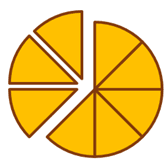
In mathematics, a fraction is a number that represents a office of a whole. It consists of a numerator and a denominator. The numerator represents the number of equal parts of a whole, while the denominator is the total number of parts that make up said whole. For instance, in the fraction of
, the numerator is three, and the denominator is 8. A more illustrative instance could involve a pie with 8 slices. 1 of those 8 slices would constitute the numerator of a fraction, while the full of 8 slices that comprises the whole pie would be the denominator. If a person were to eat 3 slices, the remaining fraction of the pie would therefore be
equally shown in the epitome to the correct. Notation that the denominator of a fraction cannot be 0, as information technology would make the fraction undefined. Fractions can undergo many different operations, some of which are mentioned below.
Addition:
Unlike calculation and subtracting integers such as two and eight, fractions require a common denominator to undergo these operations. One method for finding a common denominator involves multiplying the numerators and denominators of all of the fractions involved by the product of the denominators of each fraction. Multiplying all of the denominators ensures that the new denominator is certain to be a multiple of each individual denominator. The numerators also need to be multiplied past the appropriate factors to preserve the value of the fraction as a whole. This is arguably the simplest way to ensure that the fractions have a common denominator. Still, in almost cases, the solutions to these equations volition not appear in simplified form (the provided calculator computes the simplification automatically). Below is an case using this method.
This process tin can be used for whatever number of fractions. Just multiply the numerators and denominators of each fraction in the problem by the production of the denominators of all the other fractions (non including its own respective denominator) in the problem.
An alternative method for finding a common denominator is to determine the least common multiple (LCM) for the denominators, then add together or subtract the numerators equally 1 would an integer. Using the least common multiple can be more efficient and is more than likely to result in a fraction in simplified form. In the example above, the denominators were four, 6, and 2. The to the lowest degree common multiple is the commencement shared multiple of these three numbers.
| Multiples of ii: 2, 4, 6, eight 10, 12 |
| Multiples of 4: 4, 8, 12 |
| Multiples of 6: half-dozen, 12 |
The first multiple they all share is 12, so this is the to the lowest degree mutual multiple. To consummate an addition (or subtraction) problem, multiply the numerators and denominators of each fraction in the problem by whatever value will make the denominators 12, then add the numerators.
Subtraction:
Fraction subtraction is substantially the same as fraction addition. A common denominator is required for the operation to occur. Refer to the addition section too equally the equations below for clarification.
Multiplication:
Multiplying fractions is adequately straightforward. Unlike adding and subtracting, information technology is non necessary to compute a mutual denominator in social club to multiply fractions. Merely, the numerators and denominators of each fraction are multiplied, and the result forms a new numerator and denominator. If possible, the solution should be simplified. Refer to the equations below for description.
Division:
The process for dividing fractions is similar to that for multiplying fractions. In gild to divide fractions, the fraction in the numerator is multiplied by the reciprocal of the fraction in the denominator. The reciprocal of a number a is simply
. When a is a fraction, this essentially involves exchanging the position of the numerator and the denominator. The reciprocal of the fraction
would therefore exist
. Refer to the equations below for clarification.
Simplification:
It is often easier to work with simplified fractions. As such, fraction solutions are unremarkably expressed in their simplified forms.
for instance, is more cumbersome than
. The calculator provided returns fraction inputs in both improper fraction form as well as mixed number form. In both cases, fractions are presented in their lowest forms by dividing both numerator and denominator past their greatest common factor.
Converting between fractions and decimals:
Converting from decimals to fractions is straightforward. It does, however, require the understanding that each decimal place to the right of the decimal point represents a power of 10; the first decimal place existence ten1, the 2d xii, the third x3, and then on. Simply determine what power of 10 the decimal extends to, use that power of 10 as the denominator, enter each number to the correct of the decimal signal as the numerator, and simplify. For example, looking at the number 0.1234, the number 4 is in the 4th decimal place, which constitutes x4, or x,000. This would make the fraction
, which simplifies to
, since the greatest mutual factor between the numerator and denominator is two.
Similarly, fractions with denominators that are powers of 10 (or tin be converted to powers of 10) can exist translated to decimal form using the aforementioned principles. Accept the fraction
for example. To convert this fraction into a decimal, first convert it into the fraction of
. Knowing that the first decimal identify represents ten-i,
can exist converted to 0.5. If the fraction were instead
, the decimal would then be 0.05, and and so on. Across this, converting fractions into decimals requires the operation of long division.
Common Engineering Fraction to Decimal Conversions
In technology, fractions are widely used to describe the size of components such as pipes and bolts. The nearly common fractional and decimal equivalents are listed below.
| 64th | 32nd | sixteenth | eightth | 4th | 2nd | Decimal | Decimal (inch to mm) |
| 1/64 | 0.015625 | 0.396875 | |||||
| ii/64 | ane/32 | 0.03125 | 0.79375 | ||||
| 3/64 | 0.046875 | ane.190625 | |||||
| iv/64 | 2/32 | one/16 | 0.0625 | 1.5875 | |||
| 5/64 | 0.078125 | i.984375 | |||||
| vi/64 | 3/32 | 0.09375 | 2.38125 | ||||
| 7/64 | 0.109375 | ii.778125 | |||||
| 8/64 | four/32 | two/16 | 1/8 | 0.125 | 3.175 | ||
| nine/64 | 0.140625 | iii.571875 | |||||
| 10/64 | 5/32 | 0.15625 | iii.96875 | ||||
| 11/64 | 0.171875 | 4.365625 | |||||
| 12/64 | six/32 | 3/16 | 0.1875 | four.7625 | |||
| 13/64 | 0.203125 | v.159375 | |||||
| xiv/64 | 7/32 | 0.21875 | 5.55625 | ||||
| 15/64 | 0.234375 | v.953125 | |||||
| 16/64 | 8/32 | iv/16 | ii/8 | 1/4 | 0.25 | 6.35 | |
| 17/64 | 0.265625 | half-dozen.746875 | |||||
| 18/64 | 9/32 | 0.28125 | seven.14375 | ||||
| 19/64 | 0.296875 | seven.540625 | |||||
| 20/64 | 10/32 | 5/16 | 0.3125 | 7.9375 | |||
| 21/64 | 0.328125 | 8.334375 | |||||
| 22/64 | 11/32 | 0.34375 | 8.73125 | ||||
| 23/64 | 0.359375 | 9.128125 | |||||
| 24/64 | 12/32 | 6/xvi | 3/8 | 0.375 | 9.525 | ||
| 25/64 | 0.390625 | ix.921875 | |||||
| 26/64 | xiii/32 | 0.40625 | 10.31875 | ||||
| 27/64 | 0.421875 | 10.715625 | |||||
| 28/64 | 14/32 | 7/16 | 0.4375 | 11.1125 | |||
| 29/64 | 0.453125 | xi.509375 | |||||
| 30/64 | 15/32 | 0.46875 | xi.90625 | ||||
| 31/64 | 0.484375 | 12.303125 | |||||
| 32/64 | 16/32 | 8/sixteen | four/eight | 2/four | 1/ii | 0.5 | 12.seven |
| 33/64 | 0.515625 | thirteen.096875 | |||||
| 34/64 | 17/32 | 0.53125 | 13.49375 | ||||
| 35/64 | 0.546875 | thirteen.890625 | |||||
| 36/64 | eighteen/32 | 9/16 | 0.5625 | 14.2875 | |||
| 37/64 | 0.578125 | fourteen.684375 | |||||
| 38/64 | 19/32 | 0.59375 | xv.08125 | ||||
| 39/64 | 0.609375 | fifteen.478125 | |||||
| twoscore/64 | twenty/32 | 10/sixteen | 5/viii | 0.625 | 15.875 | ||
| 41/64 | 0.640625 | 16.271875 | |||||
| 42/64 | 21/32 | 0.65625 | 16.66875 | ||||
| 43/64 | 0.671875 | 17.065625 | |||||
| 44/64 | 22/32 | eleven/16 | 0.6875 | 17.4625 | |||
| 45/64 | 0.703125 | 17.859375 | |||||
| 46/64 | 23/32 | 0.71875 | 18.25625 | ||||
| 47/64 | 0.734375 | xviii.653125 | |||||
| 48/64 | 24/32 | 12/16 | 6/8 | 3/4 | 0.75 | 19.05 | |
| 49/64 | 0.765625 | 19.446875 | |||||
| 50/64 | 25/32 | 0.78125 | 19.84375 | ||||
| 51/64 | 0.796875 | 20.240625 | |||||
| 52/64 | 26/32 | 13/16 | 0.8125 | twenty.6375 | |||
| 53/64 | 0.828125 | 21.034375 | |||||
| 54/64 | 27/32 | 0.84375 | 21.43125 | ||||
| 55/64 | 0.859375 | 21.828125 | |||||
| 56/64 | 28/32 | xiv/xvi | vii/eight | 0.875 | 22.225 | ||
| 57/64 | 0.890625 | 22.621875 | |||||
| 58/64 | 29/32 | 0.90625 | 23.01875 | ||||
| 59/64 | 0.921875 | 23.415625 | |||||
| threescore/64 | 30/32 | fifteen/16 | 0.9375 | 23.8125 | |||
| 61/64 | 0.953125 | 24.209375 | |||||
| 62/64 | 31/32 | 0.96875 | 24.60625 | ||||
| 63/64 | 0.984375 | 25.003125 | |||||
| 64/64 | 32/32 | 16/sixteen | 8/viii | 4/4 | ii/2 | 1 | 25.iv |

3 Divided By 4 Fraction,
Source: https://www.calculator.net/fraction-calculator.html
Posted by: pennywilsock.blogspot.com
0 Response to "3 Divided By 4 Fraction"
Post a Comment